How to Choose the Right Seamless Steel Tube for Your Projects
In the modern industrial landscape, the selection of appropriate materials is pivotal for achieving durability and performance in engineering projects. Seamless steel tubes have emerged as an indispensable choice across sectors such as construction, automotive, and energy, owing to their inherent strength, resistance to pressure, and versatility. According to a recent market report by ResearchAndMarkets, the seamless steel pipe market is projected to grow at a CAGR of over 6% through 2027, driven by increasing demand in oil and gas exploration, as well as the rise in infrastructure development globally.
Choosing the right seamless steel tube necessitates a comprehensive understanding of its specifications, applications, and the conditions under which it will operate. Factors such as the chemical composition, wall thickness, and diameter are crucial in ensuring that the chosen tube not only meets project requirements but also adheres to industry standards. With standards set by organizations like ASTM and ISO, it becomes essential for engineers and project managers to be well-versed in these guidelines to optimize the performance and safety of their projects. As the demand for high-quality seamless steel tubes continues to rise, informed decision-making based on relevant data and industry trends is crucial for successful project outcomes.

Understanding the Basics of Seamless Steel Tubes
Seamless steel tubes are essential components in various industries, offering strength and flexibility for a multitude of applications. Understanding the basics of these tubes is crucial for making informed decisions when selecting the right type for your project. Seamless steel tubes are manufactured by extruding steel and forming a hollow tube without any seams, enhancing their structural integrity and resistance to pressure compared to welded tubes.
When considering seamless steel tubes, factors such as material specifications, dimensions, and intended use become pivotal. Applications may vary significantly—from structural supports in construction to hydraulic cylinders in machinery—each requiring different properties. Familiarity with standard specifications, such as ASTM or ASME, helps in identifying the appropriate steel grade needed for durability and performance under specific environmental conditions. Additionally, recognizing the manufacturing techniques and quality control processes can aid in choosing tubes that meet both safety and performance standards, ensuring the success of your projects.
Identifying the Key Specifications for Your Project Needs
When embarking on a project that requires seamless steel tubes, it's essential to understand the key specifications that will meet your unique needs. The first consideration is the tube's material grade, which can greatly influence its strength and durability. Seamless tubes are often available in a variety of grades, including low-carbon, high-tensile, and corrosion-resistant options. Selecting the right grade ensures that the tube can withstand the operational stresses it will face in its intended application.
Another critical specification is the tube's dimensional characteristics, including wall thickness and outer diameter. These factors play a crucial role in determining the tube's pressure and structural capabilities. For projects requiring high-pressure applications, opting for a thicker wall might be necessary. Additionally, understanding the required length is vital for minimizing waste and ensuring the efficient use of resources.
Tips: Always consult the project specifications to identify the necessary pressure ratings and load requirements. Additionally, consider working closely with suppliers to gain insights into material properties and suitable grades for your application. Finally, don't overlook the importance of proper installation techniques, which can also affect the performance of the seamless steel tubes in your projects.
Evaluating Manufacturing Processes and Their Impact on Quality
When selecting the right seamless steel tube for your projects, understanding the various manufacturing processes is crucial as it directly influences the final product's quality. The two predominant manufacturing methods—hot rolling and cold drawing—each offer unique advantages that can impact the mechanical properties of the tubes. Data from the World Steel Association shows that seamless tubes produced via hot rolling typically exhibit better ductility and toughness at elevated temperatures, which is essential for applications in industries such as oil and gas. Conversely, cold-drawn tubes provide superior dimensional accuracy and surface finish, making them preferable for applications requiring tight tolerances and aesthetic considerations.
Quality control is integral to the seamless steel tube manufacturing process, with rigorous standards established by organizations such as ASTM and ISO. A report by Technavio highlights that implementing advanced quality assurance techniques, such as non-destructive testing (NDT) methods, can increase defect detection rates by up to 95%. This rigor helps ensure that only the highest quality tubes are delivered, thereby reducing the risk of failure in critical applications. Furthermore, choosing manufacturers that adhere to stringent quality standards not only guarantees material integrity but also enhances the overall safety and durability of the projects that rely on these materials.
How to Choose the Right Seamless Steel Tube for Your Projects - Evaluating Manufacturing Processes and Their Impact on Quality
| Dimension (inches) |
Material Grade |
Manufacturing Process |
Yield Strength (psi) |
Cost per Foot ($) |
| 2 x 0.5 |
A106 Grade B |
Hot Finished |
60,000 |
2.00 |
| 3 x 0.75 |
A53 Grade B |
Cold Drawn |
52,000 |
3.50 |
| 1.5 x 0.5 |
SAE 1020 |
Hot Finished |
45,000 |
1.50 |
| 4 x 1 |
ASTM A500 |
Seamless |
70,000 |
4.00 |
| 2.5 x 0.75 |
A519 |
Cold Drawn |
55,000 |
3.25 |
Assessing Material Grades and Their Applications in Different Industries
When selecting a seamless steel tube, understanding the material grades is crucial, as different industries have specific requirements that dictate the appropriate grade for their applications. For instance, the energy sector often relies on high-grade tubes for oil and gas transportation, where materials must withstand extreme pressure and corrosive environments. Grades such as ASTM A106 and A333 are commonly used in these applications, offering enhanced strength and durability under challenging conditions.
In the construction and infrastructure sectors, the choice of steel tube grade may focus on structural integrity and load-bearing capacity. Grades like ASTM A500, which provides excellent weldability, are widely adopted for structural applications, ensuring safety and reliability in building projects. Conversely, industries that require high thermal and mechanical properties, such as aerospace or automotive, often utilize advanced high-strength steel grades, designed to withstand rigorous performance demands. Assessing the specific requirements of your project and matching them with the appropriate material grade is vital for achieving optimal functionality and longevity.
Choosing Reliable Suppliers and Ensuring Product Traceability
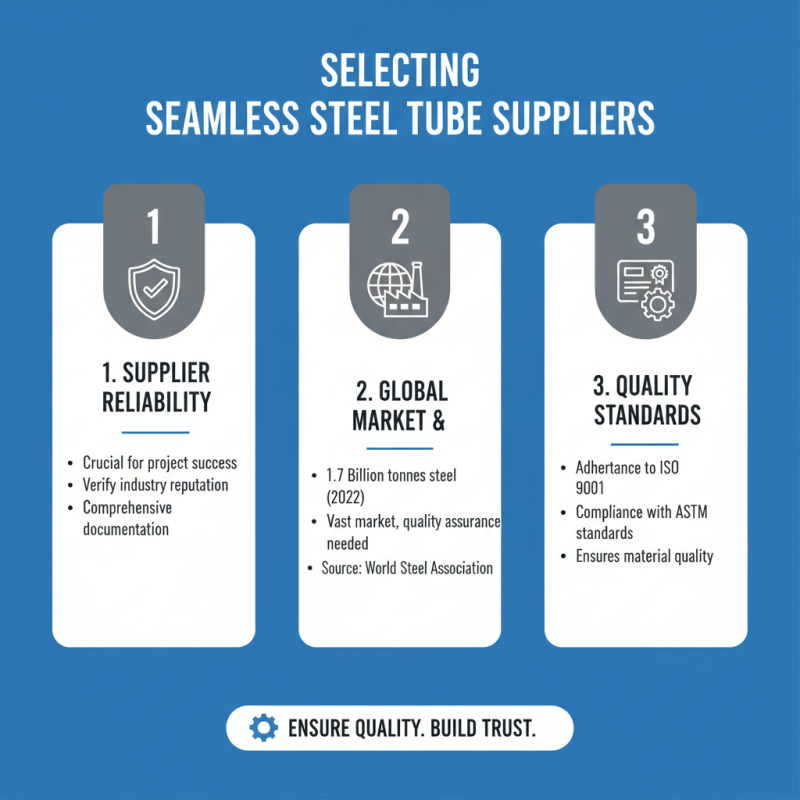
When selecting seamless steel tubes for your projects, the reliability of your suppliers is crucial. According to a report by the World Steel Association, approximately 1.7 billion tonnes of steel were produced globally in 2022, highlighting the vast market and the need for quality assurance. Engaging with suppliers who adhere to established standards such as ISO 9001 and ASTM ensures that the materials you receive meet specific quality benchmarks. It is essential to verify that your chosen suppliers have a solid reputation in the industry and provide comprehensive documentation of their manufacturing processes.
Ensuring product traceability is another critical factor that cannot be overlooked. The American Society for Testing and Materials (ASTM) emphasizes the importance of traceability in the steel industry, stating that a transparent supply chain can significantly reduce the risk of defects and improve accountability. By obtaining mill test reports (MTRs) and certification from suppliers, customers can trace the origin of the steel tube, ensuring compliance with required specifications. This traceability not only enhances safety but also aids in meeting regulatory standards for various applications, particularly in sectors such as oil and gas, construction, and automotive manufacturing.